
Heart valve disease can affect how efficiently the heart pumps blood. When a valve becomes narrowed, stiff, or leaky, patients may experience breathlessness, tiredness, chest discomfort, dizziness, or swelling in the legs. Depending on the severity, treatment may include medicines, monitoring, a catheter-based procedure, valve repair, or valve replacement.
Patients searching for a Heart Surgery Hospital in Nashik may wonder whether repairing the damaged valve is better than replacing it. In many suitable cases, preserving the patient’s own valve is preferred. However, repair is not always possible or durable. The decision depends on the valve involved, the type of damage, the patient’s age and health, and the experience of the heart team.
What Is Heart Valve Repair?
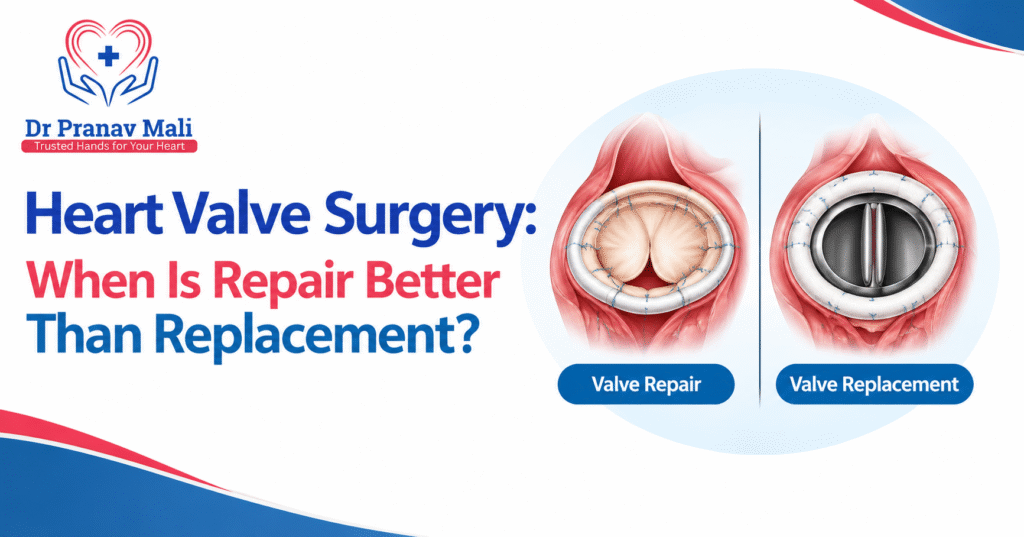
Heart valve repair is a procedure that corrects the damaged parts of a natural valve while preserving the patient’s own valve tissue. The surgeon may reshape the valve, repair torn tissue, tighten or support the valve ring, or correct problems with the structures that help the valve open and close.
Repair is commonly considered for certain mitral valve and tricuspid valve conditions. Some aortic and pulmonary valve problems may also be repaired in selected patients.
The American Heart Association explains that valve repair is generally preferred when it can provide a safe and durable result. Preserving the natural valve may help maintain the normal structure and function of the heart.
Common valve repair techniques include:
- Repairing or reshaping valve leaflets.
- Removing or supporting damaged tissue.
- Repairing or tightening the valve ring using an annuloplasty ring.
- Replacing or repairing supporting chords.
- Using selected catheter-based techniques for suitable patients.
- Widening a narrowed valve through balloon valvuloplasty in selected cases.
The exact technique depends on the location and cause of the valve problem.
What Is Heart Valve Replacement?
Heart valve replacement involves removing a severely damaged valve and replacing it with an artificial valve. Replacement may be required when the valve is too thickened, calcified, infected, damaged, or structurally unsuitable for repair.
There are two main types of replacement valves.
Mechanical Valve
A mechanical valve is made from durable artificial materials. It can last for many years, but patients generally need lifelong blood-thinning treatment with warfarin. Regular blood tests and medication monitoring are important to reduce the risk of blood clots and bleeding.
Biological or Tissue Valve
A tissue valve is made from animal tissue or, in some cases, donated human tissue. These valves usually do not require lifelong warfarin only because of the valve itself, although anticoagulation may be needed for another medical reason.
Tissue valves may gradually wear out over time. The expected durability depends on the patient’s age, the valve position, health conditions, and the type of valve used.
The choice between a mechanical and tissue valve involves age, pregnancy plans, bleeding risk, lifestyle, ability to take anticoagulants, and the possibility of another procedure in the future.
When Is Valve Repair Better Than Replacement?
Valve repair may be preferred when the surgeon expects a successful and durable result. The benefits can be especially important in suitable mitral valve disease.
1. The Natural Valve Can Be Preserved
Repair keeps the patient’s own valve and may preserve the normal movement of the valve and supporting structures. This can help the heart maintain its natural function.
2. Long-Term Blood Thinners May Be Avoided
A successful repair generally does not require lifelong anticoagulation solely because of the repair. This can be an important advantage for patients who have a high bleeding risk or difficulty attending regular blood tests.
However, blood thinners may still be required for other conditions, such as atrial fibrillation.
3. The Risk of Prosthetic Valve Complications May Be Reduced
Replacement introduces an artificial valve. Depending on the type, possible concerns include blood clots, bleeding, infection, structural deterioration, or the need for another procedure.
Repair may avoid some prosthetic valve-related complications when it remains effective over the long term.
4. Repair May Offer Better Results in Selected Mitral Valve Conditions
According to American College of Cardiology and American Heart Association guidance, repair is recommended over replacement for certain patients with severe primary mitral regurgitation when a successful and durable repair is possible. The guidelines also emphasise that repair outcomes depend strongly on valve anatomy and surgical expertise.
Repair is particularly favourable when the damage is limited and the valve can be restored without significant remaining leakage.
When Is Valve Replacement a Better Option?
Although repair is desirable in suitable cases, replacement may be safer when repair would be incomplete, unreliable, or unlikely to last.
Replacement may be considered when:
- The valve is severely calcified or rigid.
- The valve tissue is extensively damaged.
- Infection has destroyed important valve structures.
- Rheumatic disease has caused advanced thickening or scarring.
- The valve has already undergone an unsuccessful repair.
- There is severe narrowing that cannot be corrected adequately.
- The anatomy makes a durable repair unlikely.
- The patient has complex disease involving several valve structures.
A poor or temporary repair may lead to persistent leakage, repeated symptoms, heart failure, or another operation. For this reason, the goal is not simply to repair the valve at any cost. The goal is to achieve the safest and most durable result.
The ACC and AHA guidance recognises that valve replacement may be preferable to an unsuccessful or unreliable repair. A durable replacement can sometimes provide a more predictable long-term outcome.
How Do Doctors Decide Between Repair and Replacement?
The decision is based on detailed testing and assessment by a multidisciplinary heart valve team.
Important factors include:
- Type of valve disease: Leakage and narrowing may require different approaches.
- Valve anatomy: The surgeon evaluates the leaflets, supporting chords, valve ring, and surrounding tissues.
- Severity of disease: Mild disease may only need monitoring or medicines.
- Heart function: Echocardiography helps assess pumping function, chamber size, and pressure changes.
- Symptoms: Breathlessness, chest discomfort, fainting, fatigue, and swelling may influence timing.
- Age and general health: Kidney disease, lung disease, diabetes, frailty, and other conditions affect risk.
- Previous surgery: Earlier procedures may cause scar tissue or alter the valve structure.
- Durability of the expected repair: A repair should be likely to remain effective over time.
- Patient preferences: Lifestyle, pregnancy plans, anticoagulation concerns, and future procedures matter.
- Surgeon and hospital experience: Complex valve repair should be performed by an experienced team with appropriate facilities.
An echocardiogram is usually central to the evaluation. Additional tests may include transesophageal echocardiography, CT scans, cardiac catheterisation, blood tests, or other investigations depending on the case.
Questions to Ask Before Valve Surgery
Before making a decision, patients should ask:
- Which valve is affected?
- Is repair technically possible?
- How likely is the repair to remain successful?
- What are the risks of repair compared with replacement?
- If repair is attempted, could replacement become necessary during surgery?
- Which replacement valve would be suitable if replacement is needed?
- Will lifelong blood thinners be required?
- How long is recovery expected to take?
- What follow-up tests will be needed?
- What experience does the surgical team have with this procedure?
A second opinion from an experienced valve team may be helpful when the decision between repair and replacement is complex.
Conclusion
Heart valve repair is often preferred when the natural valve can be preserved safely and the result is expected to be durable. It may reduce the need for lifelong anticoagulation and avoid some complications associated with artificial valves. However, replacement may be the better choice when the valve is severely damaged or a reliable repair is unlikely.
Dr. Pranav Mali provides specialised cardiac evaluation and surgical guidance for patients with valve disease and other heart conditions. Through detailed testing, personalised treatment planning, and an experienced heart team approach, patients can understand whether repair or replacement is appropriate. Consult Dr. Pranav Mali when looking for a Heart Bypass Specialist in Nashik.
#HeartValveSurgery #HeartValveRepair #HeartValveReplacement #CardiacSurgery #HeartHealth #Cardiology #HeartSurgery #DrPranavMali